I have a high-performing team. Now what?

When a team is high performing, it can be all too easy for the Scrum Master to say, "Whelp, that's it! Mission accomplished."
But a high-performing Scrum team creates a good problem: How do you keep the team embracing continuous improvement when things are already going well?
Here are 5 ideas to keep improving both customer outcomes and the way the team works.
1) Make micro improvements. We don't need a whole system overhaul to improve. Small improvements are easier to try, evaluate and keep when they work.
A modified minimum specs exercise can help. Let the the team first dream big and then bring it down to practical baby steps.

2) Look for impediments outside the Scrum team. Sometimes a high-performing team can exist within an environment that is... less than high performing.
Newer Scrum Masters often begin by focusing closely on one Scrum team. As the team becomes more self-sufficient, the Scrum Master's focus can expand outward. Look for policies, incentives, dependencies and tooling that make good work harder than it needs to be.

Some things the Scrum Master might look at include:
Is change control slowing useful work?
Are individual incentives undermining team behavior?
Are there opportunities to promote pair programming?
Could new AI tools remove repetitive work?
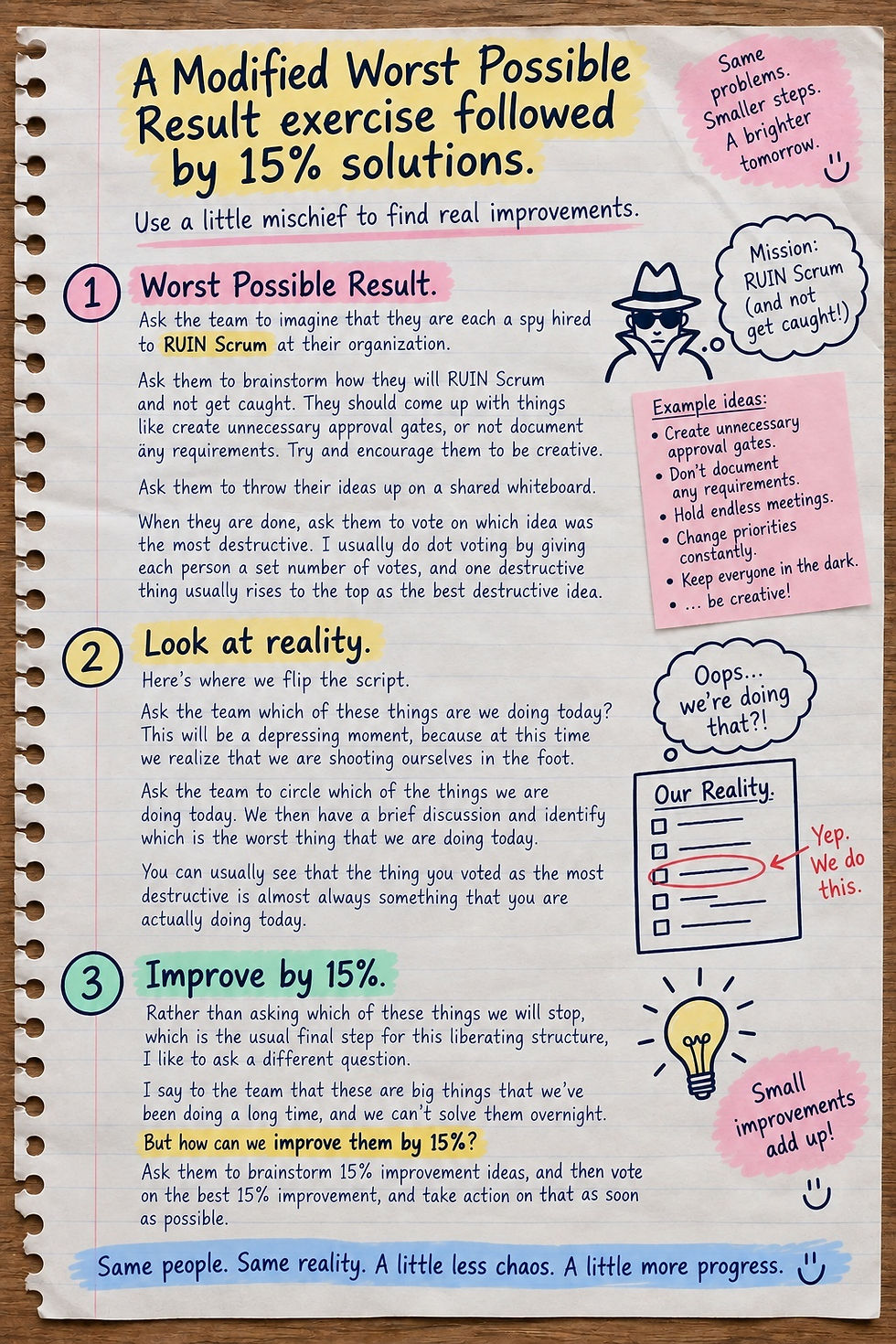
If the team has trouble identifying system-level impediments, try a modified Worst Possible Result TRIZ Liberating Structure exercise followed by a 15% Solutions exercise at your Sprint Retrospective. Here's how that could work.
3) Measure outcomes, not output. Even high-performing teams need to make sure that they are focusing on the right things.
Ask what has changed for the customer because of the team's work. What problem should become smaller? What evidence would tell you if you're succeeding?
If your Scrum team struggles to answer those questions, Evidence-Based Management can give you a useful framework. Try taking a Professional Agile Leadership – Evidence-Based Management (PAL-EBM) class together as a team.
4) Revisit how you're using AI. AI is changing so fast that even a high-performing team should be regularly asking whether they are using it well.
Are there repetitive tasks that AI could help with? Could AI summarize recurring themes from several Retrospectives? Help turn rough acceptance criteria into a first draft? Reduce the time spent turning workshop notes into usable documentation? And are there new AI tools available today that weren't available six months ago?
The goal isn't to maximize AI use. It's to remove low-value work without outsourcing judgment, collaboration or accountability. Bring the question to the Sprint Retrospective every once in a while: What are we doing today that AI could help us do better, faster, or not at all? You might be surprised by what the team comes up with.
5) Make the team less dependent on you. One sign of a self-sufficient Scrum team is that continuous improvement doesn't stop when the Scrum Master isn't in the room.
If you've been the Scrum Master for a high-performing team for a while, there's a pretty good chance that everyone knows how a Sprint Retrospective works. So why are you still leading every single one?
Try taking turns. Ask a different team member to facilitate the Sprint Retrospective each Sprint. They don't have to facilitate it the way that you do. In fact, that's kind of the point. Give them the freedom to try a different format, ask different questions, or experiment with a new facilitation technique.
This gets the team more involved in their own continuous improvement and helps keep the Sprint Retrospective from becoming the Scrum Master's meeting. You're still there to help if they need you, but over time the team should become less dependent on you to make improvement happen. That's a pretty good sign that you're doing your job.
Conclusion
Things are always changing. That's why we use Scrum after all. Even a high-performing team will face new challenges, new technology, new organizational impediments, and new opportunities to improve. So there really is no point where the Scrum Master gets to say, "Whelp, we're done here!"
What does change is where the Scrum Master spends their time. As a team becomes more mature and more capable of improving on their own, the Scrum Master can start looking outward, tackling organizational impediments and helping other teams improve as well.
As that happens, the Scrum Master may have the capacity to support more than one Scrum Team. That doesn't mean attending every meeting or hovering over every team. If a mature team still needs its Scrum Master involved in absolutely everything, that's probably another opportunity for improvement.
The goal isn't to make yourself indispensable. It's to help create teams that can keep getting better. Even when you're not in the room.