The Agile Mindset
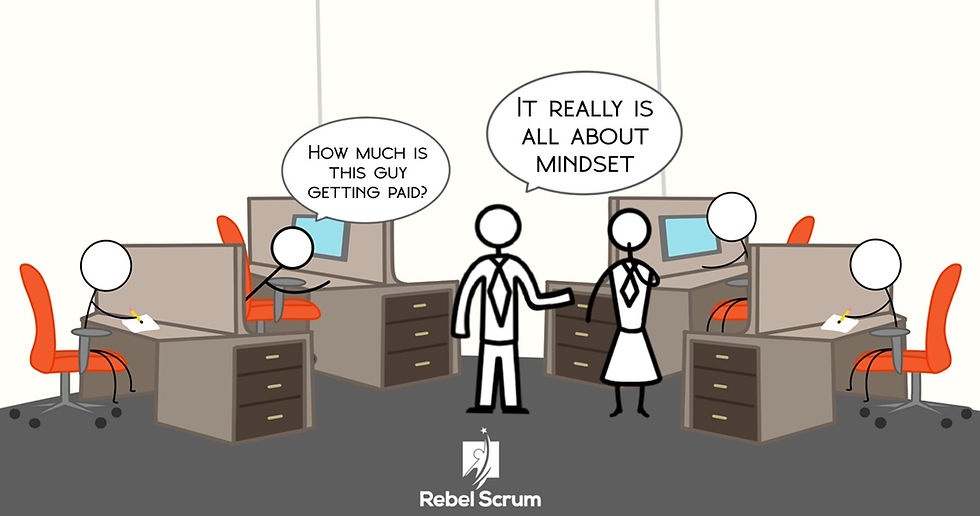
I used to roll my eyes when highly-paid consultants would stand in front of leadership and say things like “Agile is a mindset” or “We need an Agile mindset shift.”
But damn it… they were right.
There really is an Agile mindset. And if you’re using Scrum without it, you’re most likely just going through the motions. And you could be leaving a lot of value on the table - not to mention creating a lot of waste.
So, what do I actually mean by “Agile mindset”? Let’s get specific.
1. We’re Open to the Plan Changing (But We Still Need Direction)
An Agile mindset means accepting that we don’t know everything upfront, and that’s okay.
This shows up in how we plan.
We don’t create a massive, detailed project plan or a big requirements document up front, because we know reality will teach us new things as we go.
That being said, this doesn't mean it's ok to drift like a ship without a rudder, with no direction at all.
The Product Owner should create alignment around a direction of travel. They need to communicate what is their vision of the future product. They should create a Product Goal which is a step towards their future vision. And they should be continuously refining a Product Backlog and (ideally) a roadmap or forecast which is their strategy on how to get there. If it sounds like a lot of work, well, that's because it is. The Product Owner is a very strategic accountability in Scrum. Without a strategic Product Owner, you don't have a strategy.
But there is a balance to be had here. The Product Owner is not a "bad" Product Owner if the plan changes. We need to be open to learning and adapting. Changing the plan isn’t a failure — it’s proof that we’re learning from reality and from customer feedback. And that's a good thing.
However, there are exceptions! I’ve seen a few fast-moving environments where the Product Owner keeps a very thin Product Backlog and the team planned mostly in Sprint Planning based on fresh feedback. That can work when the domain truly demands it.
But be honest with yourself: Is your Product Backlog thin because you’re being highly responsive to change — or because the Product Owner role isn’t properly staffed and you’re just winging it?
And along these lines, how much of a Product Backlog do you need? One Sprint's worth? Nothing? It depends on your environment and how fast user needs are evolving. A Product Backlog is usually a good thing, but in a rapidly involving environment it can also be a waste of time as well.
The bottom line here is that you have to do what's right for your product. Or as Dwight D. Eisenhower once said, "As Plans are worthless, but planning is everything."
2. Incremental Delivery is not failure
Scrum mindset means being comfortable delivering value in small, usable pieces instead of waiting for the “perfect” complete product.
Think Polaroid instead of digital photos. The product emerges over time.
This is powerful because it gets working software/working product in front of real users and stakeholders early. Their feedback quickly tells us what’s valuable and what isn’t. It reduces both business risk and technical risk.
Many people struggle with this idea. They want to build everything before showing it to anyone. That feels safer — until you discover months later that you built something nobody actually wanted.
Incremental delivery forces humility and learning. That’s the point.
3. Transparency, Inspection, and Adaptation
This is foundational.
We must be willing to be transparent about how we’re doing — even when the news isn’t pretty. We inspect regularly (in every Scrum event including the Daily Scrum and the Sprint Review), and we adapt based on what we learn.
Without transparency, there is no real inspection or adaptation. It all becomes theater.
4. The Scrum Values Are Not Decorations
Courage, Focus, Openness, Respect, and Commitment aren’t just nice words on a poster.
They are the behaviors that create the psychological safety and trust required for real transparency and improvement. If your team doesn’t live these values, Scrum will stay shallow and mechanical. (For more on this topic, check out The 5 Scrum Values and the Real World)
5. Collaboration Over Individual Heroics
A team working well together will outperform a group of smart individuals working alone.
Real collaboration leads to better creativity, better quality, and better solutions. This requires letting go of the “my code / my task” mentality and embracing collective ownership. Try pair programming once, and you'll be a believer!
Bottom Line
You can run all the Scrum events, use all the right terminology, and still not get all of the value from Scrum that you could be getting if you don’t have the right mindset.
The Agile mindset is uncomfortable for many people because it requires humility, openness to change, and a willingness to be wrong sometimes.
But when individuals and organizations actually adopt it, Scrum stops being just window dressing and starts becoming a real force for change.
So next time someone says “It’s all about the mindset,” don’t roll your eyes. Lean in and ask - what can we do to improve?